INDIA'S 2005 SUMMER MONSOON
 |
Map of the normal dates of onset of India's summer monsoon (shaded in green) and the actual dates for the 2005 season (full image). From the India Meteorological Department. |
The map to the right (full image), from the India Meteorology Department, combines the average dates of the onset of the summer monsoon with the actual dates from the 2005 season. For example, summer monsoon season traditionally starts in the extreme southern portion of India prior to June 1. On average, the summer monsoon extends to the extreme northwest corner of the country and the entire subcontinent is under its influence by July 15.
The map also contains the actual date that the summer monsoon began in selected cities. For example, onset of the summer monsoon in Ranchi, located in northeastern India and circled in red on the map, was determined to have occurred on June 10, 2005. Even though the onset and withdrawal of India's monsoons follow a regular pattern, the beginning of a specific phase can vary dramatically from year to year. The ebb and flow of the summer monsoon may appear as a tide flowing over India, but it is far less predictable.
The 2005 summer monsoon was characterized by both a late arrival and an early progression over the entire country. In a May 19, 2005 interview, Dr. M. Rajeevan, Director-Forecasting at the India Meteorological Department (IMD) attributed the monsoon's delay to a couple of factors; namely weak cross-equatorial wind and below normal temperatures. Let's first examine Dr. Rajeevan's comment regarding the wind.
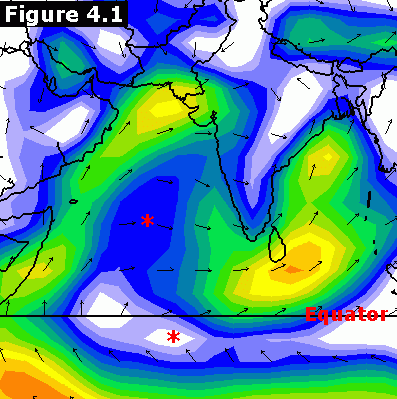
Figure 4.1 represents the long-term mean surface wind speed (in meters per second) for the month of May, while figure 4.2 provides mean surface wind speed only for May 2005. The wind during May 2005 in the central basin of the Arabian Sea and the region just south of the Equator in the Indian Ocean (both areas are identified with a red asterisk) is significantly weaker than the long term mean. For example, long-term mean wind speed in the central Arabian Sea is generally 4 to 6 meters per second (9 to 13 miles per hour), while in May of 2005 most of this same area had a mean wind speed of less than 2 meters per second (4 miles per hour). The transport of moist air to India, which is so vital to the summer monsoon, was severely hindered.
|
|
|
(Left) Long-term mean surface wind (in meters per second) for May (full image). (Right) Mean surface wind (in meters per second) for May 2005 (full image). A comparison of wind speed in the Arabian Sea and in the Indian Ocean just south of the Equator shows that the wind in May 2005 was much weaker than the long-term mean. This led to a late onset of the 2005 summer monsoon. Image provided by the NOAA-CIRES Climate Diagnostics Center, Boulder, Colorado. |
||


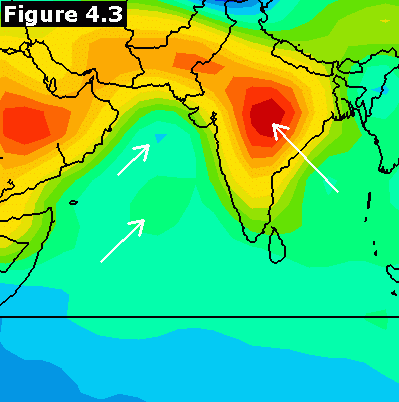
Dr. Rajeevan mentioned that below normal heating in May 2005 was also a factor in the late onset. Figure 4.3 displays the long-term mean air temperature for May while figure 4.4 provides the mean air temperature for May 2005. The differences are subtle but no less important. First, notice that the dark red bullseye in northern India that represents temperatures of nearly 38° Celsius (100° Fahrenheit) in May 2005 (Figure 4.4) is much smaller than on the chart of long term temperature (Figure 4.3). The northern Arabian Sea was also a few degrees cooler in 2005 as identified by the area of light blue shading. As has been discussed earlier, the warming of Northern India and Nepal plays a critical role in the development in the summer monsoon. As the charts below demonstrate, this process lagged slightly in May.
|
|
|
(Left) Long-term mean air temperature (in degrees Celsius) for May (full image). (Right) Mean air temperature (in degrees Celsius) for May 2005 (full image). The differences between the long-term mean and May 2005 are subtle but are clearly present in the Arabian Sea and northcentral India. Conditions in May 2005 were a few degrees cooler than average and this suppressed onset of the summer monsoon. Image provided by the NOAA-CIRES Climate Diagnostics Center, Boulder, Colorado. |
||


It is possible to track the onset and withdrawal of the monsoons by examining the daily precipitation totals. For example, the chart below (Figure 4.5) tracks precipitation for Ranchi, India for the one year period ending on October 22, 2005. The upper portion of the graphic presents the running total for the specified period and a comparison of actual and average year to date totals. Although considerable precipitation occurred during the 2005 summer monsoon, the chart shows that an overall deficit of 16 inches, or almost 30% of the annual average amount, existed at the end of October. As the summer monsoon has withdrawn at this point, this precipitation shortfall is likely to be endured until the summer monsoon returns next year.
|
||
|
Graphic representation of daily (lower half) and total period-to-date precipitation (upper half) for Ranchi, India for the year ending October 22, 2005 (full image). The upper portion of the chart also shows the relationship between the average accumulated rainfall and the actual year-to-date total. In this instance, the brown shaded area represents a shortage in year-to-date precipitation. Image provided by the NOAA-CIRES Climate Diagnostics Center, Boulder, Colorado. |
|


The lower half of the chart provides the precipitation total for each day of the year in increments of inches on the left and millimeters on the right. It clearly shows the spike in total daily precipitation rates in mid June that heralded the beginning of the 2005 summer monsoon, and the corresponding decline in late September that marked its withdrawal. A review of the daily totals demonstrates that the summer monsoon isn't a linear event where a substantial amount of precipitation falls each day. Rather, it is the overall tendency of the summer monsoon to be associated with rain that distinguishes it from the winter monsoon.
Shortly after the onset of the summer monsoon, Ranchi experienced a few days where the total precipitation was considerably higher than the average for the year. To gain an understanding of the dynamics at work during this period, we must examine monsoon depressions.